
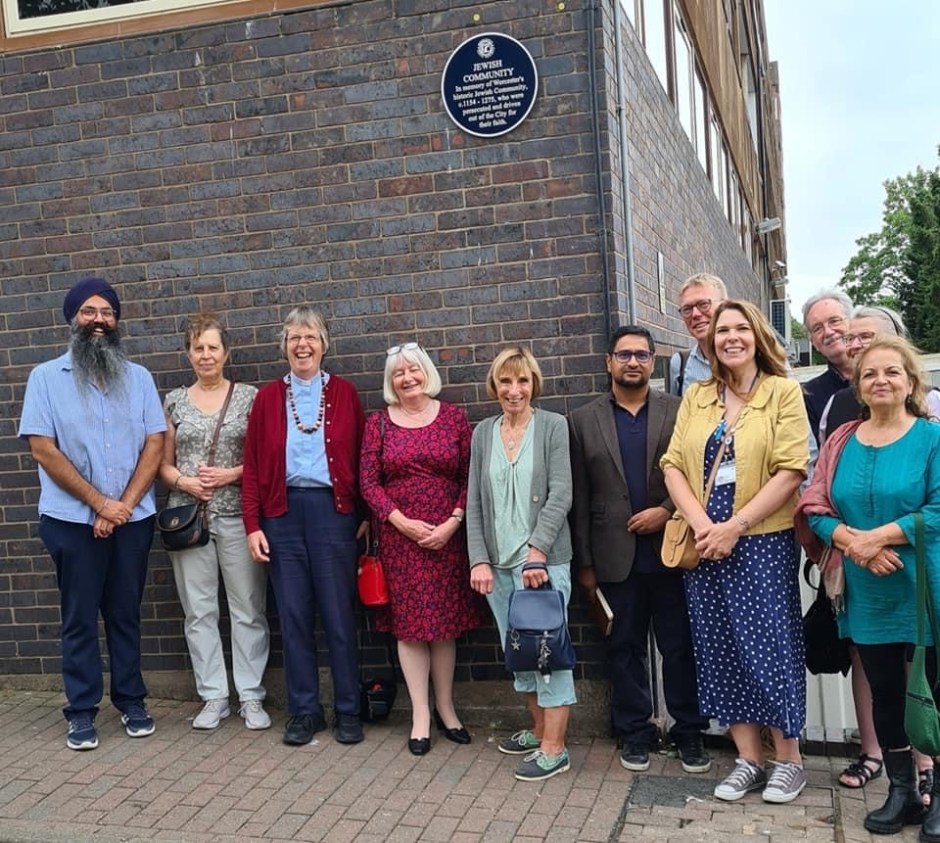
In July the plaque was unveiled commemorating the medieval Jewish community of
Worcester. Yvonne Stollard has written a super article about the event.
A talk on ‘The Worcester Jewry (c. 1158-1275): A Persecuted Community?’
By Yvonne Stollard
We only expected around 10-15 people to come to this talk, so were amazed when 75 people turned up.
We had to send for extra chairs! Most were local, but some had come from Birmingham, and one couple travelled from Wales. The impetus for this talk was the unveiling of a plaque to commemorate Worcester’s medieval Jewish community. The idea for the plaque came from Mark T. Jones, a local man who spent some time researching the history of this community. Sadly, he died last summer before his project came to fruition.
Little is known of the social history of this community as documentary evidence is scarce. There is no apparent physical indication of their presence either, and the report of a recent archaeological dig has yet to be published. It was thought that a talk prior to the unveiling would help to make people aware of the little-known history of this community, and medieval Jewish communities in England generally.
Our speaker, Dean Irwin, recently gained his PhD in Medieval Jewish History, and was recommended by the Jewish Historical Society of England. He hadn’t been to Worcester before, and knew little of its history, so he had to do some homework.
We do know a few things about Worcester and the Jews – Jews arrived in England with William the Conqueror, and gradually set up small communities in important towns, although London remained the main centre for Jewry. The Worcester community was established in 1158 and seems to have been an outpost of the Hereford community.
The 1240 Synod of Worcester required that, “When men and women magicians shall be found, and also such as consult Jews for the purpose of finding magic about their life or actions, they shall be brought before the bishop to be punished in accordance with his decision.” This probably had more to do with prejudice and superstition rather than witchcraft.
In 1241, a ‘Jewish Parliament’, aka the “Worcester Parliament’, was convened by King Henry III. He
summoned representatives from all the Jewish communities in England to Worcester, and 100 Jews attended. The purpose was not to give these communities a say in government, but to levy an even higher tallage. Although the Jewry was probably not large, it was important enough to have an ‘archa’, a chest where transactions with Jews were kept – Jewish moneylending had been regulated by the Crown since 1194, and this was a legal requirement.
Although the Worcester Jewry was sacked by the Earls of Leicester and Derby in 1263, Jews continued to live in Worcester until 1275 when Edward I expelled them from the city. The reason was that his mother, Eleanor of Provence, insisted on it. Dean posited that she did this not because of their religion, but because she wanted to do penance for having benefitted and profited from her dealings with Jews, and this was a way of achieving it. His question was, were the Jews expelled because of their religion, or was it usurers who were expelled for their moneylending, or was it because of Eleanor’s concern for her soul? I’m not sure the whys and wherefores matter that much when the fact is that Worcester’s Jewish community was expelled, whilst other groups were not.
Some of us were taken aback when Dean suggested the Jews of Worcester had not actually been
persecuted as no documentary evidence has been found. But what about the Synod of Worcester?
Although there was no social media as we know it today, word would have spread of the blood libels in, for example, Norwich, Lincoln, and York, accusations that had no basis in fact. They would probably have heard of the Crusaders ‘adventures’ provoking attacks on Jewish communities across Europe. Surely they would have heard of the blood libel concerning Harald of Gloucester (1168) – Gloucester being only 26 miles down the River Severn. It wouldn’t be beyond credibility that these stories would have spread like Chinese whispers and been embellished and exaggerated. Prejudice, repression, persecution, whether by Worcester’s leaders or the Crown at one time or another, was directed at Jewish communities.
Unfortunately, Dean didn’t delve into the Church’s teachings on Jews at the time. This was a pity as they will have had an impact on medieval society and the treatment of Jews at all levels.
The unveiling of the plaque took place by the entrance to Copenhagen Street Car Park on Friday 22nd July 2022 at 10.30am. The plaque is situated on the corner of HOW College.
 Worcestershire Interfaith Forum