
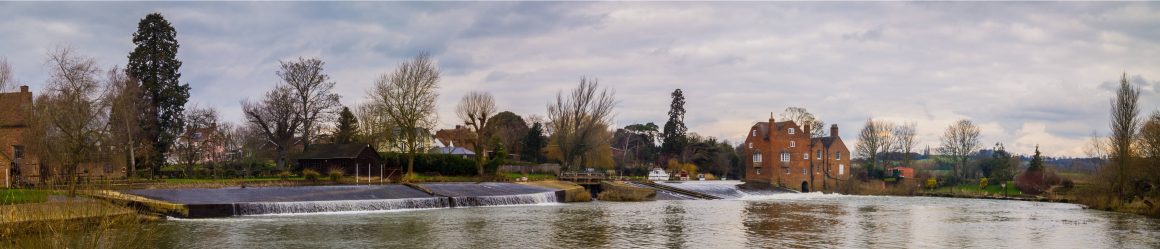

On 11th November 2019, at Holland House Retreat Centre near Evesham, the Worcestershire Interfaith Forum held a conference on Climate Change. The speakers included two professionals working in the fields of science and sustainability, and a team of people describing their different faith perspectives on this topic.
The Science of Climate Change
The standard for our day on climate change and how different faith communities respond to its challenges, was set high by our keynote speaker, Dr Martin Hodson. Amongst many other roles, Martin is Principal Tutor in Christian Rural and Environmental Studies at Oxford Brookes University, as well as an author and freelance speaker.
In a fascinating and thought-provoking talk on the science of climate change, Martin began by explaining that climate change is only one of several environmental problems we are facing, with the nitrogen cycle and soil degradation also giving cause for concern. A decade ago, we had already exceeded what are deemed to be safe levels of all of these. Our Carbon Dioxide Emissions are the biggest worry as these have been rising steadily since the Industrial Revolution. In the simplest terms, Martin explained that atmospheric methane escaping from oil wells, fracking activities, etc are becoming trapped in the atmosphere and warming the planet. 93.4% of this increased heat is going into the oceans which in turn causes sea levels to rise. If this continues at its present rate, by the end of this century, (some predictions put it as early as 2050), Bangladesh will be below sea-level, causing 9 million people to move away from their homes. Research carried out this year showed that the Arctic Ice Cap is at its lowest level ever and could disappear completely by as early as the 2030s. This would have devastating consequences; the cap is vital for cooling the planet as it reflects back heat from the earth.
The effects of climate change for us in the UK will be increasingly extreme weather with hotter, drier summers and colder, wetter winters. We will see fewer people dying from cold and may find we can grow more varieties of crops further north. We will, however, find more “Climate Refugees” seeking to enter the country.
The United Kingdom is placed in the top ten countries able to survive climate change, but this does not mean we can – or should – ignore the issue. All faiths agree that we have a responsibility to care for the planet and for all – animals and people – who live on it and will be affected by climate change.
The 2005 Paris Meeting made an enormous impact as governments agreed to take action on this issue but far more needs to be done – and done urgently. In 2013 Richard Muller – originally a Climate Change Sceptic but later convinced by his own research, of the enormity of the problem – wrote that human activity was almost entirely to blame for climate change.
So, what can we do about it:
Measure our own carbon footprint and look for ways to reduce it;
Lobby MPs to take the issue seriously and make it a priority; and
Buy British! We are the best county in terms of reducing our carbon emissions industrially, but we are importing more goods, which means we are causing other countries to emit more!
There is no room for complacency!
Footsteps – different faith perspectives
A series of speakers gave the perspective of different faiths on the issue of climate change: Anglican, Muslim, Jewish, Quaker and Buddhist. Apart from the Buddhist speaker, Chris Haynes, the group had been arranged by Ruth Tetlow, Chair of ‘Footsteps: Faiths for a low Carbon Future’, an interfaith group set up in Birmingham in 2015. Ruth gave examples of Christian engagement with climate change issues in Birmingham, referring to ‘Laudato Si’, the Papal Encyclical and the Lambeth Declaration on climate change signed by leaders of all faiths in 2015. She emphasised the importance of hope and said that ‘Footsteps’ is pleased to have been given a place on the Climate Emergency Task Force set up by Birmingham City Council. Footsteps have issued a valuable report on the role of faith communities in tackling the Climate emergency.
Nikhat Panjwani spoke about teachings in the Holy Qur’an on the subject of caring for God’s creation and told the conference about a number of initiatives in which her mosque community (the Khoja Shi’a mosque in Clifton Road Balsall Heath) have been involved, including urging their members to bring their own mugs to the mosque for refreshment during Ramadhan, to avoid the use of plastic cups.
David Harrison endorsed a similar approach from the perspective of the Birmingham Progressive Synagogue, and shared some of his experiences of visiting the Antarctic where he saw disturbing signs of climate change happening.
The final speaker on behalf of Footsteps was Harriet Martin, of Cotteridge Quaker Meeting. She told the conference how the Quaker Meeting had made a commitment to being as near to carbon neutral as possible. They had taken a large number of practical steps including insulation and solar panels, to reduce their carbon footprint to a minimum. Harriet and her husband Chris had also converted their own home and regularly opened it to show the public how they had installed a wide range of green features.
From policy to practice: How the University of Worcester has attempted to embed sustainability
Katy Boom, Director of Sustainability at the University of Worcester, enthusiastically, and with a wealth of data, described how a public commitment to sustainability is being translated from aspiration into significant and measurable change at the University of Worcester. From an initial commitment signed in 2008 by the University Chancellor, the University identified where and how, within the life of the University and in the lifestyle of staff and students, the greatest impact can be made.
Katy’s most recent annual report is entitled “Change today. Protect tomorrow”, and is in the public domain. Progress in attaining published sustainable development goals, for example in procurement, teaching, research and efficiency, is very carefully monitored and has resulted in the University being the first University in England to receive a Gold EcoCampus Award. In the “People and Planet” League table Worcester is currently placed 5th equal among British Universities. Two very remarkable achievements!
Katy highlighted some projects designed to impact on the understanding and lifestyles of staff and students including “10 Golden Rules. Living Sustainably in Worcester”, ten very practical and down to earth ways of making a personal difference. She referred to the “Go Green Week” on campus and to a two-year pilot Bike Share scheme which caught the attention of “Midlands Today”. The commitments made by the University and the very significant impacts being made can be read online: https://www.worcester.ac.uk/about/sustainability
Following this fascinating and informative Climate Change Conference, the Worcestershire Interfaith Forum published a statement:
The representatives of the Baha’i, Buddhist, Christian, Jewish, Muslim, Quaker, Sikh Faith traditions of Worcestershire, state that as Brothers and Sisters in both Faith and common Humanity, we uphold the sacredness of the Earth and all its dependent life, including its seas, forests, mountains and plains. We believe the words of the Great Native American, Chief Seattle, (Duwamish Tribe) are true – that “Humankind has not woven the web of life. We are but one thread within it. Whatever we do to the web, we do to ourselves. All things are bound together. All things connect”.
We are all deeply concerned about the state of our natural environment and poor stewardship of it which causes the deepening climate crisis. We therefore call upon not only Faith communities, but the politicians, businesses and social communities of Worcester to do everything within their power to nurture and sustain the environment, for the benefit of all – both present and yet to come.
Sarah Cottrill
Ruth Tetlow
Owain Bell
Ian Spencer
Yvonne Stollard
 Worcestershire Interfaith Forum